
Over 20 years experience of training in the care sector
Call us on
020 3129 5667
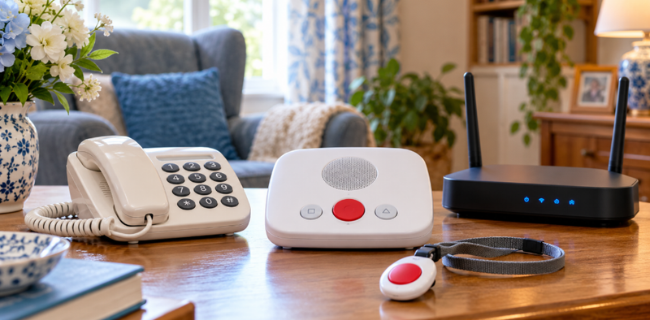
The UK’s analogue telephone network is being retired, with the government’s current timetable pointing to 31 January 2027. Care homes should confirm their own migration date directly with their communications provider, because individual lines can move earlier.
For most people, this may sound like a telecoms issue. For adult social care providers, it can be a safety and governance issue.
For registered managers and area directors, the question is no longer simply, “Has our phone line gone digital?” It is:
Have we checked every safety-critical system that depends on it?
The old public switched telephone network, usually referred to as the PSTN, has been operating for decades and is increasingly difficult to maintain. Telecoms companies are replacing it with digital, internet-based services.
The government’s Moving landlines to digital technologies guidance explains the 31 January 2027 timetable and the need to upgrade devices that rely on the public switched telephone network (PSTN).
Many devices used in care environments were designed to send signals over analogue telephone lines. Some may continue to work following migration, some may become unreliable and others may stop functioning unless they are upgraded or replaced.
DHSC is advising organisations not to leave preparations until the last minute, because identifying, procuring, installing and testing replacement systems can take longer than expected.
Do not assume this only affects the telephone sitting on reception.
DHSC specifically identifies systems that may be affected, including:
✅ Telecare or warden-call systems.
✅ Lift emergency telephone lines.
✅ Door-entry systems.
✅ Fire alarms.
✅ Security and burglar alarms.
✅ Other equipment connected to an analogue telephone line.
In grouped living environments, the situation can be particularly complex. One telecare installation may serve numerous bedrooms or flats and could also be integrated with fire detection, lifts or door-entry systems.
Recent DHSC-commissioned research found that around three-quarters of grouped-living telecare alarms in the sample were still analogue. Around one-third of personal alarms were also analogue.
This is therefore not a theoretical risk affecting only a handful of outdated systems.
Telecare can be a lifeline.
A person may press a pendant following a fall, use a pull cord when they become unwell or rely on a monitored alarm because they cannot easily reach a telephone.
Government guidance warns that analogue telecare can become unreliable or fail completely when the underlying telephone line is migrated.
For managers, that creates an important governance question.
If somebody’s risk assessment identifies an alarm as one of the controls keeping them safe, have you confirmed that the alarm will continue to work after migration?
That assurance should come from the appropriate telephone, telecare or equipment supplier rather than an assumption that because the device powers on, it remains compatible.
Digital telephone services introduce another important consideration: power resilience.
Traditional analogue networks could provide enough electricity for some basic corded phones to continue operating during a local power failure.
Digital telephone services generally depend on mains-powered routers or other equipment.
Government guidance therefore warns that digital landlines and telecare connected through them may stop working during a power cut unless suitable resilience arrangements are in place.
Emergency calling arrangements do not automatically guarantee that every telecare device will keep working. Confirm the resilience required for your service with the communications provider, equipment supplier and alarm receiving centre.
Providers therefore need to understand the complete chain: the alarm, router or communications equipment, connection to the monitoring centre and any battery or mobile back-up.
Having a battery inside the alarm itself may not be enough if another part of that chain loses power.
A change to fire alarms, lift emergency lines, telecare or door-entry arrangements should prompt consideration of whether associated risk assessments and emergency procedures need updating.
Managers may also need to review staff instructions, personal emergency evacuation plans and business-continuity arrangements.
And staff need to understand what has changed.
A technically compliant system provides limited protection if night staff do not know how to use it, where faults should be reported or what contingency arrangements apply if it becomes unavailable.
It would be easy to leave the digital switchover entirely with an IT supplier, landlord or maintenance contractor.
Registered managers do not need to become telecommunications engineers. They do, however, need assurance that systems relied upon to keep people safe remain functional, tested and supported by appropriate contingency arrangements.
For area directors and nominated individuals, there is an additional question about organisational oversight where multiple services use different buildings, suppliers and generations of equipment.
A useful governance question is:
Can we identify every safety-critical device that relies on external connectivity, explain what happens if that connection fails and demonstrate that the contingency has been tested?
If the answer is unclear, the 31 January 2027 deadline is close enough that action should start now.
CareTutor provides eLearning for health and social care. Health and Safety in Adult Social Care (Standard 13) supports risk awareness and emergency response within a worker’s role. Risk Assessment for Health & Safety in the Care Home, Fire Safety 1: Hazards & Prevention and Fire Safety 2: Drills & Evacuation provide relevant supporting learning.
Use Pathway LMS to assign relevant learning and monitor completion through its training matrix and reports. Pair this with site-specific briefings on changed equipment, fault reporting and contingencies.
Contact CareTutor to discuss relevant staff learning or arrange a Pathway LMS demonstration. For the switchover itself, obtain technical assurance from your communications provider, equipment suppliers and monitoring service before migration.
Resources
DHSC guidance for housing providers